
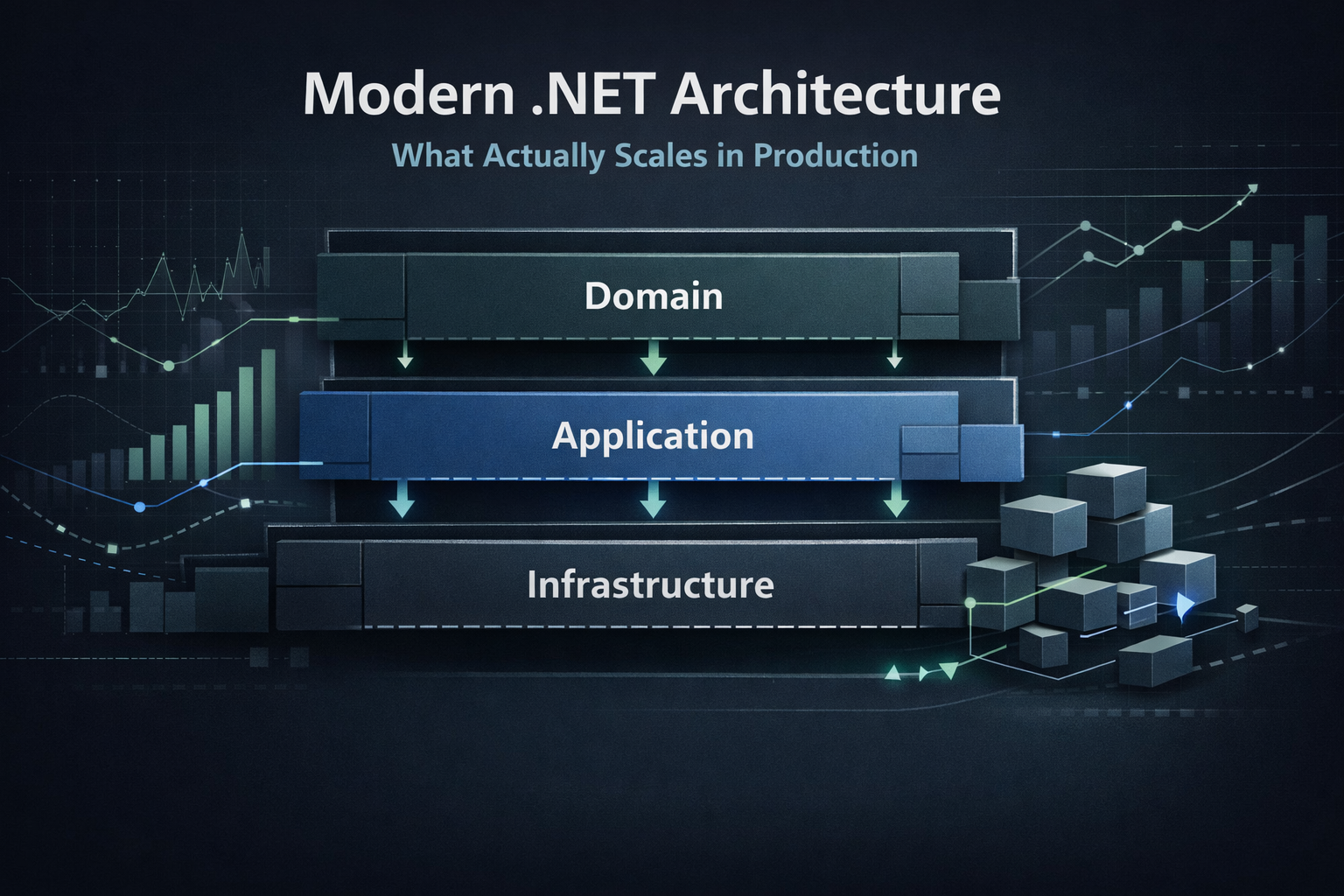

Clean demos are easy. Production systems expose architectural truth.
In real-world .NET systems, scalability problems rarely come from missing cloud services or frameworks. They come from architectural decisions that looked reasonable early on — but didn’t account for change, growth, and operational reality.
What follows are architectural principles that consistently separate .NET systems that scale from those that slowly collapse under their own complexity.
1. Explicit boundaries are more important than deployment topology
Whether you deploy a monolith or microservices, scalability starts with clear boundaries.
Architectures that scale define responsibility explicitly:
- bounded contexts
- ownership of data and behavior
- controlled dependency direction
A system with strong internal boundaries can be split later. A distributed system without boundaries only amplifies coupling.
2. Modularity is a prerequisite
In .NET systems, modularity should first be enforced inside the codebase:
- vertical slices over technical layers
- explicit contracts between modules
- isolation of domain logic from infrastructure
Only when those principles already hold does distribution (microservices) reduce complexity instead of multiplying it.
3. Data ownership defines scalability limits
Most scalability failures trace back to data, not compute.
Architectures that scale treat data as part of the domain boundary:
- one authoritative owner per model
- no shared-write databases
- integration through well-defined APIs or events
In .NET, ignoring data ownership often leads to hidden coupling that no amount of caching or scaling can fix later.
4. Concurrency and asynchrony must be architectural decisions
Async is not an optimization — it’s a design choice.
Scalable .NET systems decide early:
- where async flows are required
- how backpressure is handled
- which operations are synchronous by intent
Retrofitting async behavior into an architecture that wasn’t designed for it usually increases complexity without delivering predictable gains.
5. Observability and failure modes are part of architecture
If you can’t see your system fail, you can’t scale it.
Production-ready .NET architectures define:
- logging boundaries per component
- meaningful metrics tied to business flows
- explicit failure handling, not implicit retries
Systems that scale assume failure and make it diagnosable by design.
Bottom line:
Modern .NET architecture is not about monoliths versus microservices. It’s about enforcing boundaries, ownership, and operational clarity — early and consistently. Systems that scale are built to evolve, not just to run.