
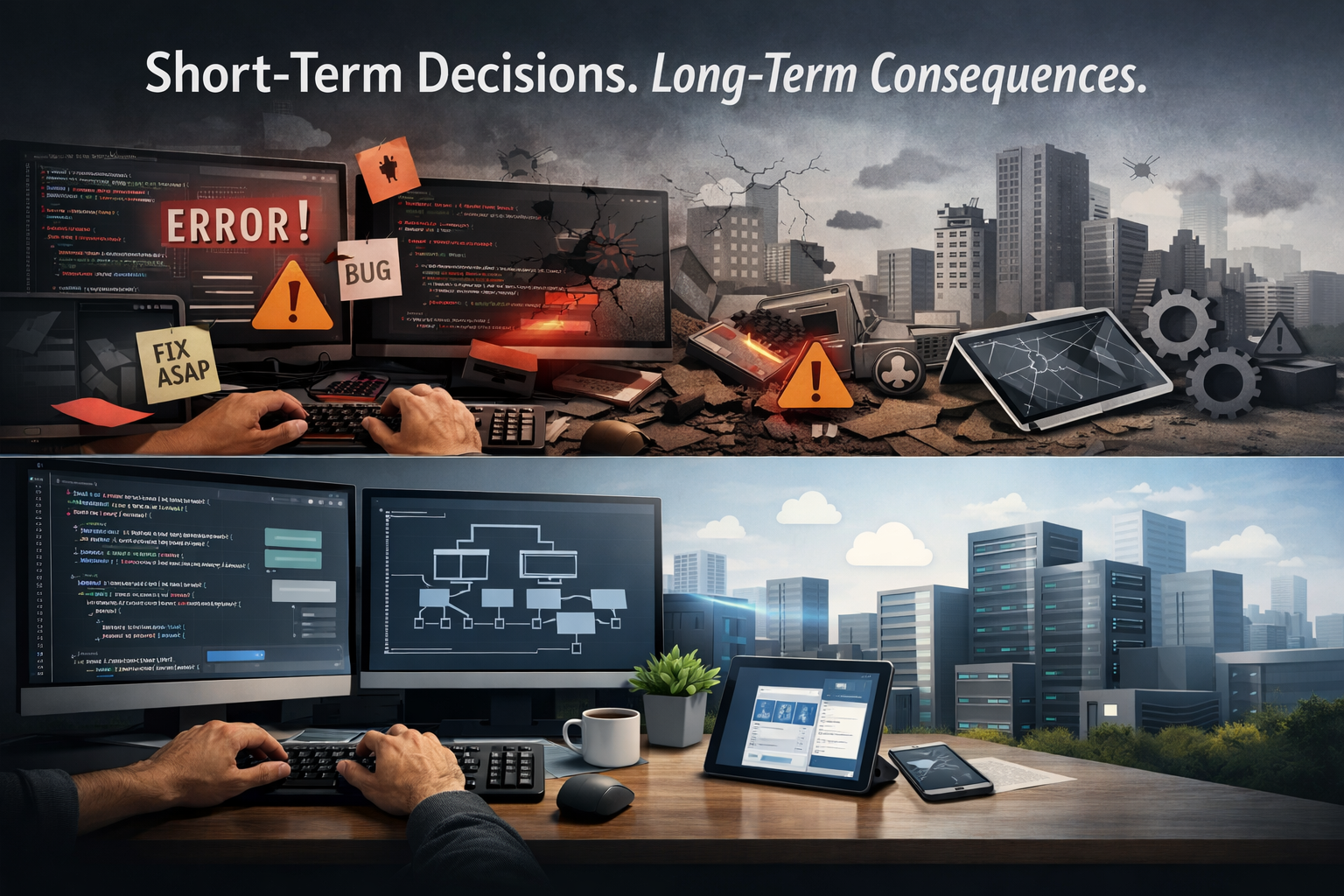

In software development, “temporary” solutions have a habit of becoming permanent.
What starts as a quick workaround to meet a deadline often ends up shaping architecture, team habits, and long-term costs. The problem isn’t short-term thinking itself — it’s making short-term decisions without long-term responsibility.
And that’s where many development models fall short.
When short-term fixes turn into long-term debt
Under pressure, teams often prioritize speed:
- a shortcut in architecture,
- minimal documentation,
- decisions optimized for today, not tomorrow.
Individually, these choices may seem reasonable. Collectively, they create technical debt that slows delivery, complicates onboarding, and limits future change. Months later, no one remembers why the shortcut was taken — only that it’s now expensive to undo.
The real issue: lack of ownership over outcomes
The hidden cost isn’t just technical. It’s organizational.
When developers are brought in only to “deliver fast,” without accountability for continuity, context, or evolution, long-term consequences are nobody’s responsibility. Decisions optimize for exit, not for sustainability.
That’s when short-term efficiency quietly turns into long-term risk.
How FlexDev approaches short-term work differently
FlexDev was designed to challenge this pattern.
Even in short-term or flexible engagements, the focus stays on:
- clean integration into existing systems,
- decisions that respect future scalability,
- continuity of knowledge beyond a single person.
A FlexDev developer works as part of the client’s team — but with the backing of a broader group that ensures architectural awareness, shared context, and long-term thinking.
The result isn’t overengineering.
It’s responsible decision-making, even under time pressure.
Why this matters more than ever
Today’s systems evolve constantly. Teams change. Requirements shift.
In this environment, short-term decisions are inevitable — but careless ones are not. Sustainable teams don’t avoid speed; they balance it with accountability.
That balance is what separates solutions that merely work today from systems that still work tomorrow.
The takeaway:
Short-term delivery doesn’t have to mean short-term thinking. Models like FlexDev exist to ensure that even temporary decisions contribute to long-term stability, not long-term problems.