
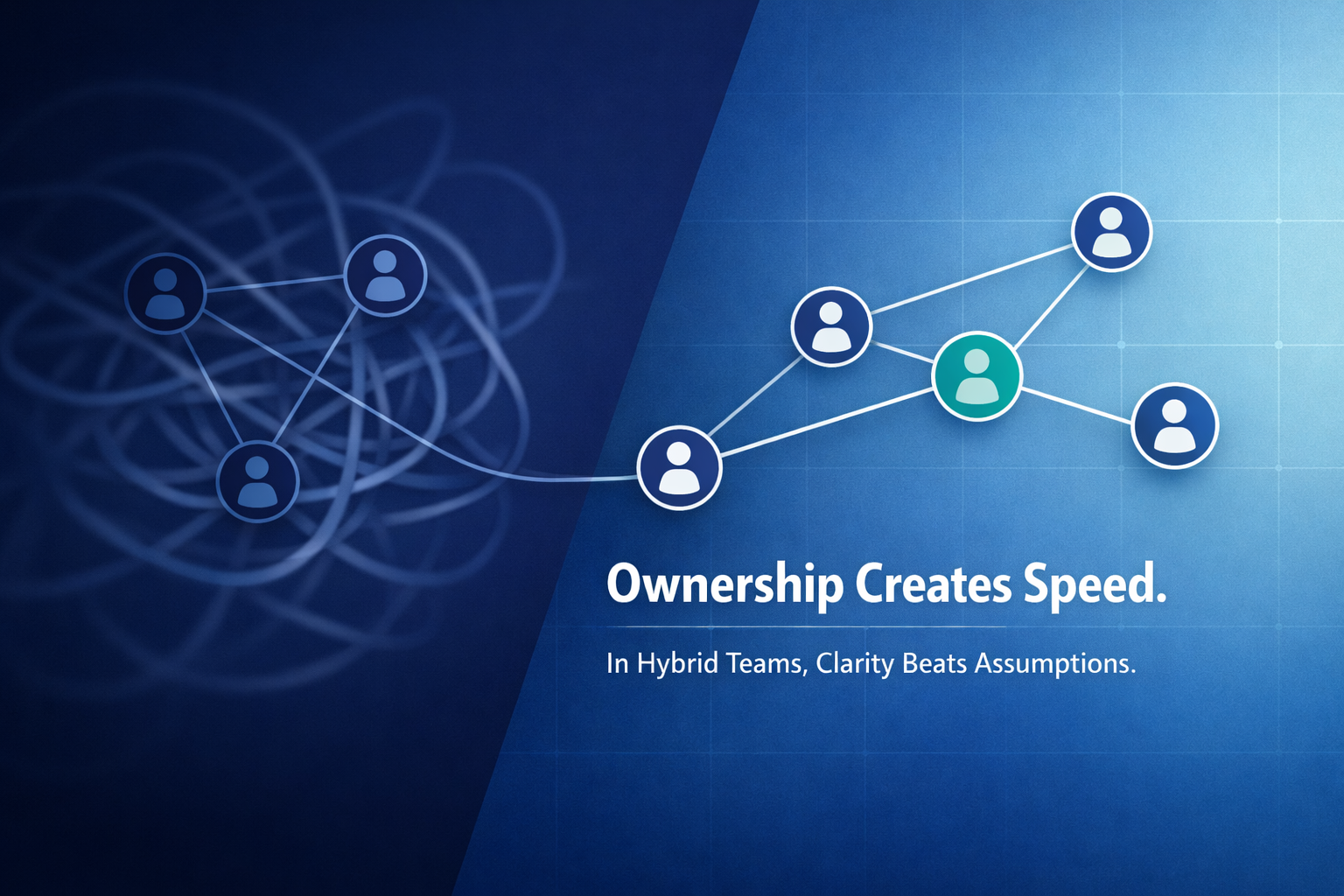

Hybrid teams are now standard.
Internal and external developers working together is no longer unusual.
But one question determines whether this model creates speed or chaos:
Who decides what?
When ownership is unclear, progress slows.
When accountability is blurred, quality drops.
When decision rights are undefined, friction replaces momentum.
1️⃣ Ownership is not contribution
Many teams confuse contribution with ownership.
Several developers may work on a feature.
But someone must own the outcome.
Ownership means long-term responsibility, architectural consistency, and final accountability for quality.
Without it, teams move but no one steers.
2️⃣ Accountability must be explicit
Hybrid setups amplify ambiguity.
Who owns architecture?
Who decides technical trade-offs?
Who has the final say on priorities?
If those answers aren’t clearly defined, alignment breaks.
Clarity reduces coordination overhead and shortens feedback loops.
It accelerates execution.
3️⃣ Decision rights define speed
Hybrid teams rarely slow down because of skill gaps.
They slow down because decisions bounce between layers.
High-performing teams define boundaries:
- What can be decided autonomously?
- What requires consultation?
- What must be escalated?
Clear decision rights remove hesitation, and hesitation kills speed.
The leadership responsibility
In hybrid environments, leadership is about designing clarity.
Define ownership.
Make accountability visible.
Align authority with responsibility.
Hybrid teams don’t create chaos.
They expose it.
And clear structure is what turns collaboration into controlled speed.