
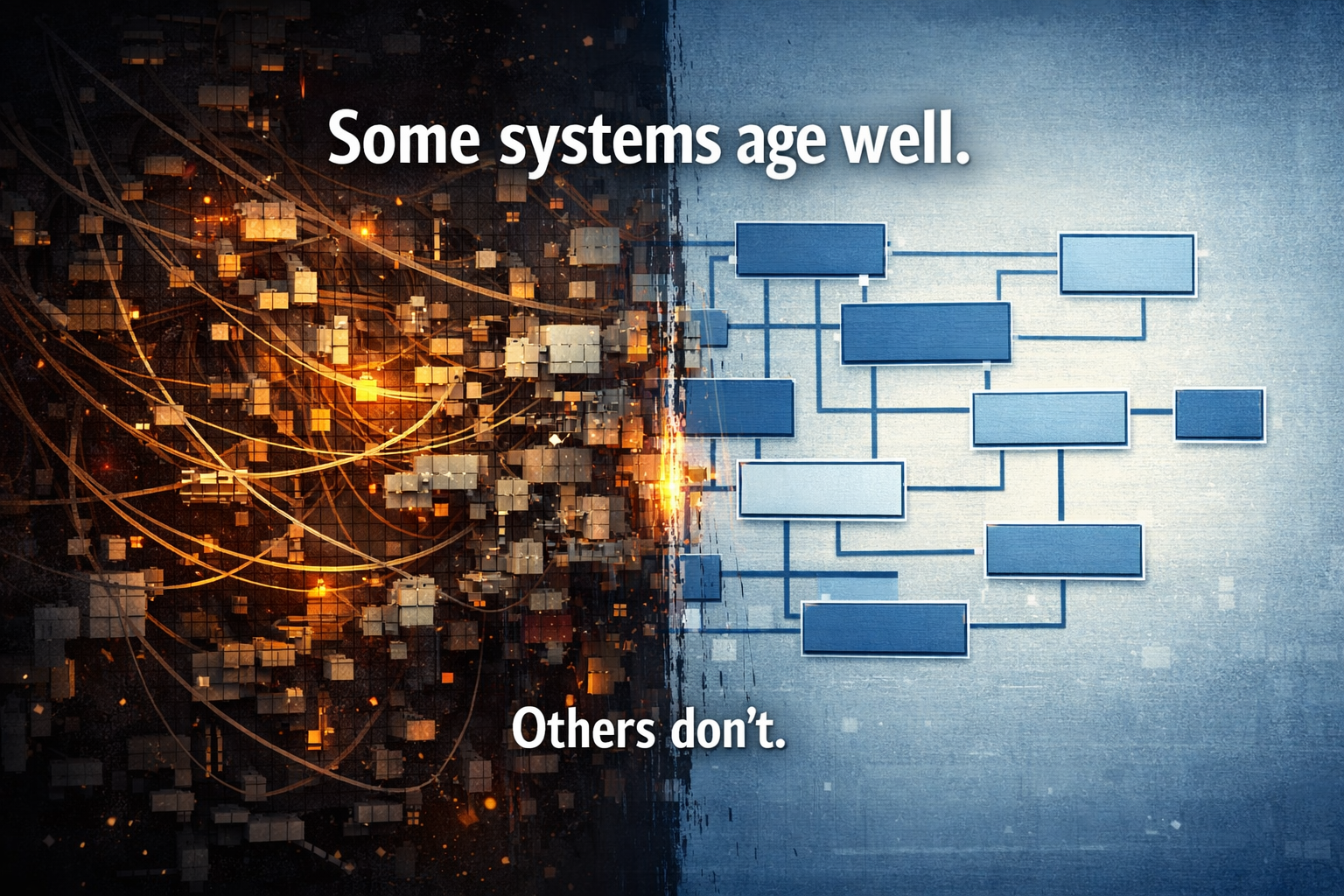

Over time, some systems become easier to change, while others become increasingly difficult.
At first glance, it might seem like a matter of complexity or age. In practice, the difference is usually in how the system was designed, and how it evolved over time.
When structure is unclear, change becomes expensive
In many .NET systems, problems don’t start with scale, but with small inconsistencies that accumulate over time.
Boundaries are not clearly defined, responsibilities begin to overlap, and logic slowly spreads across layers. At first, everything still works. But with each change, more context is needed, more caution is required, and progress becomes slower.
Well-designed systems make change predictable
Systems that age well don’t eliminate complexity. They manage it.
Components have clear responsibilities, dependencies are intentional, and the structure reflects how the system actually behaves. As a result, changes stay localized, and new features don’t require understanding the entire codebase.
Consistency over time matters more than perfection
Long-term maintainability is rarely about perfect architecture. It’s about consistency in how decisions are made and applied.
When patterns and structure remain aligned over time, the system stays understandable. Without that, even good solutions gradually turn into friction.
Systems that evolve well are designed to evolve
.NET systems naturally grow, they integrate with other services, adapt to new requirements, and change direction over time.
Teams that handle this well don’t try to predict every future scenario. Instead, they build systems that can evolve without constant rework or increasing risk.
It’s not just about code
The systems that age well are not only well-designed. They are well understood.
Shared context, clear communication, and aligned decisions play a critical role. Over time, fragmented knowledge can slow teams down even more than technical debt.
Some systems become rigid with age.
Others remain flexible.
Not because they are simpler, but because they were designed, and evolved, with change in mind.
What has made the biggest difference in how your systems age over time? 💭