
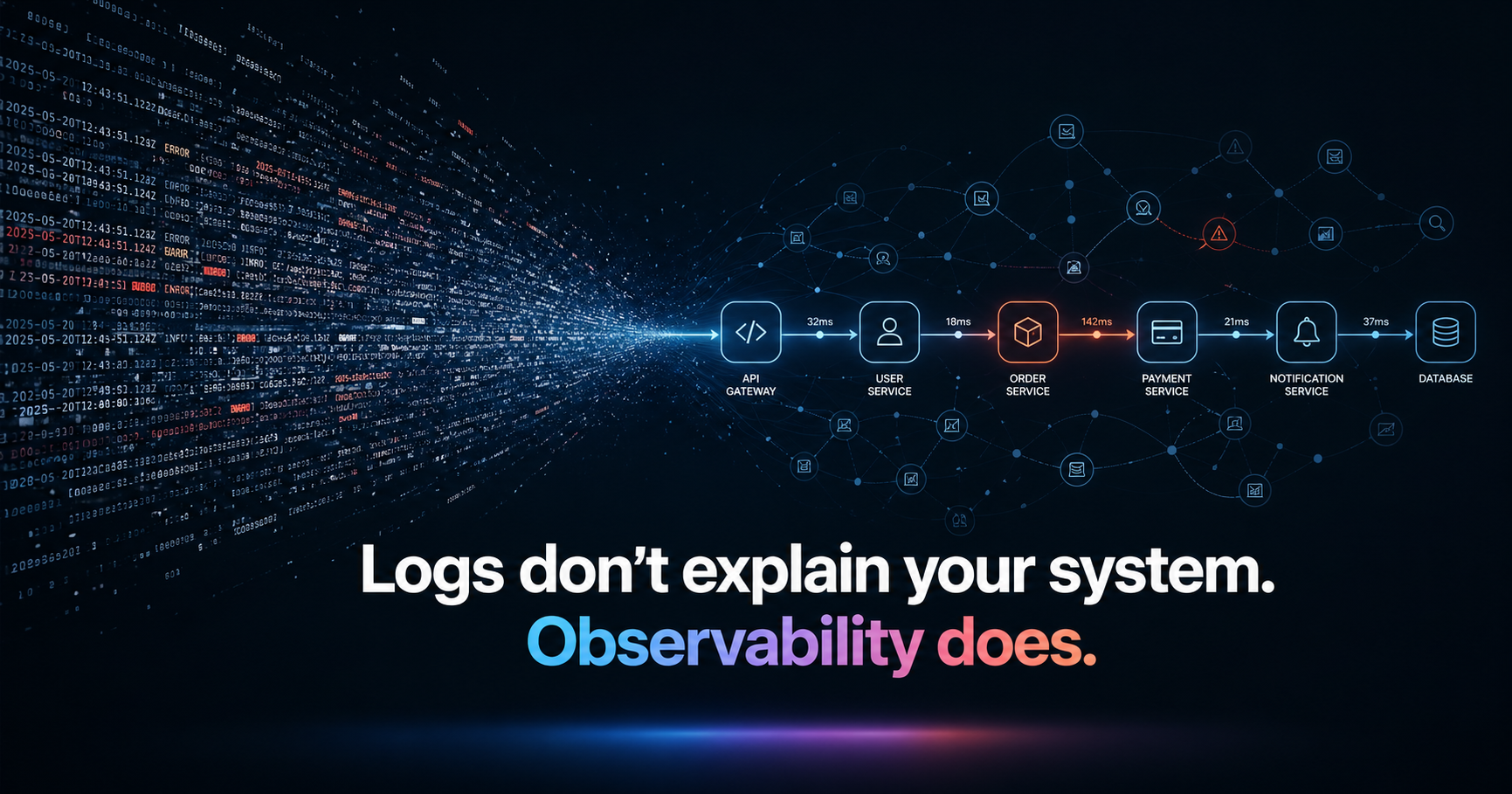

Most .NET applications today generate logs. And often, there’s no shortage of them.
Yet when something breaks in production, the first reaction is often the same: “We don’t have enough information.”
That’s not necessarily a problem of volume. More often, it’s about how the data is structured, and whether it actually answers the questions we need to ask in that moment.
Logs Alone Aren’t Enough
Logging is essential. But on its own, it’s not enough to truly understand what’s happening inside a system.
What’s missing is context.
What exactly happened across services?
Which part of the system became the bottleneck?
How did a specific request impact other components?
Without that, logs quickly turn into noise rather than answers.
Observability Is About Questions, Not Just Data
The difference between monitoring and observability isn’t just about tools. It’s about how we think about our systems.
It’s not only about collecting data, but about being able to ask the system questions we didn’t anticipate upfront.
Why did this request fail?
Where did latency occur?
What changed compared to yesterday?
And more importantly, being able to get meaningful answers.
Traces, Metrics, and Logs Need to Work Together
In the .NET ecosystem today, we have everything we need.
Structured logs.
Metrics.
Distributed tracing (e.g., via OpenTelemetry).
But real value only emerges when these layers are connected.
When you can follow a single request across services.
When you understand its impact on performance.
And when you have the right context from logs to explain why.
Instrumentation Is Part of Design, Not an Afterthought
A common mistake is treating observability as something to add once things start failing. By then, it’s usually too late.
Well-designed systems account for observability from the beginning.
Clear events.
Consistent log structures.
Meaningful metrics.
That’s what enables faster responses and reduces uncertainty.
It’s Not About Tools — It’s About Understanding the System
Tools will continue to evolve. But the ability to quickly understand what’s happening inside a system remains critical.
And that’s the real difference between simply having logs and actually understanding your system.
How does your team approach observability today, more as logging, or as a way to truly understand the system? 💭