
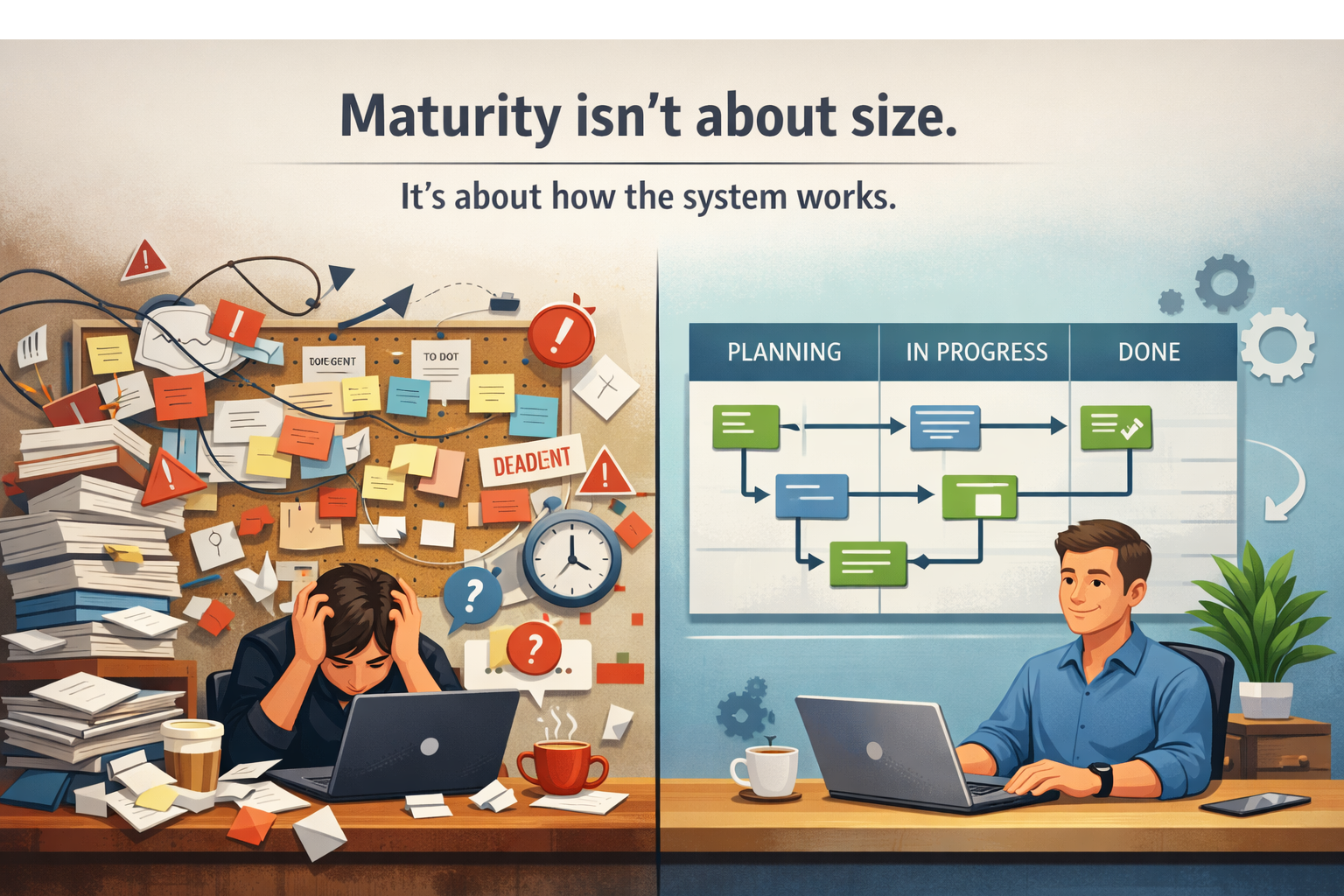

Maturity in this environment isn’t defined by team size or budget.
Large organizations can still operate in chaos, while smaller teams often work with surprising structure and clarity.
The difference lies in how teams think, plan, and collaborate — both internally and externally.
Understanding over speed
Less mature teams often optimize for speed.
More tasks completed.
More features delivered.
More mature teams take a different approach.
They invest more time in understanding the problem, because moving quickly in the wrong direction is still waste.
Planning as a continuous activity
Planning isn’t a one-off phase.
It’s an ongoing process of adjusting priorities, validating assumptions, and making decisions clearer.
Instead of reacting to change, these teams expect it, and actively work with it.
Collaboration as part of the system
In less mature organizations, external developers are often separated from the core team.
They are assigned tasks, managed, but lack context.
Mature organizations remove that gap.
They integrate external capacity into their system, sharing context, communication, and responsibility.
Because where context is missing, collaboration starts to break down.
Reducing dependency on individuals
Many teams rely on key people.
It works, until one of them is gone.
Mature organizations actively reduce this risk.
They build shared understanding, distribute knowledge, and design systems that don’t depend on a single point of failure.
Balancing speed with stability
Speed matters.
But so does what comes next.
Mature teams make decisions with both in mind, not just the next release, but the long-term impact on the system.
Because speed without stability creates friction that compounds over time.
Maturity doesn’t show in isolated decisions.
It shows in consistency.
In how teams handle complexity.
How they collaborate, and how they grow without losing control.
It’s not about size.
It’s about how the system works.
Where have you seen this kind of maturity or the lack of it, in practice? 💭