
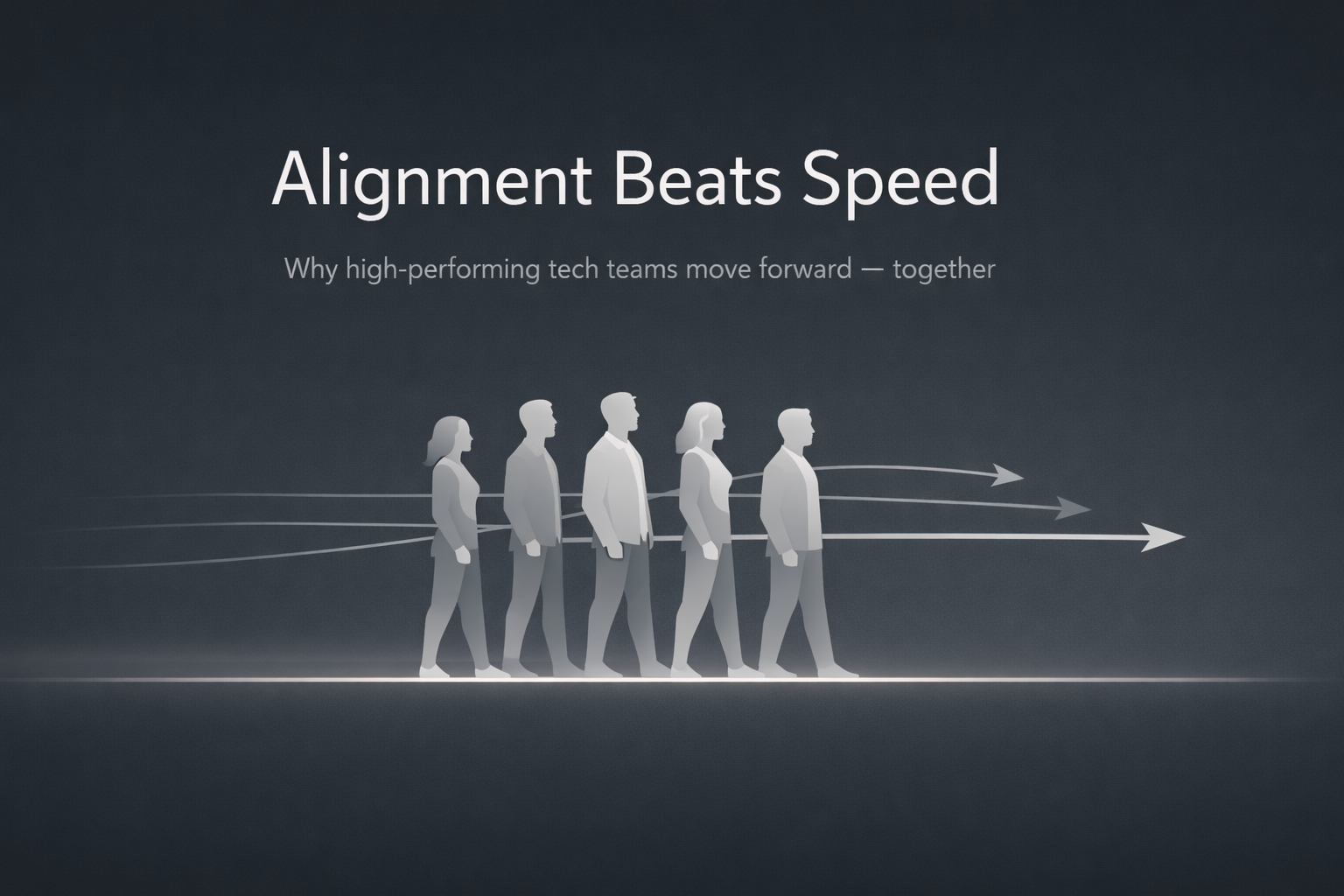

In tech, speed is often seen as the ultimate advantage.
Ship faster. Decide quicker. Move immediately.
But in high-performing teams, speed without alignment is rarely a strength. More often, it’s a risk.
Moving fast only works when everyone is moving in the same direction.
Speed amplifies misalignment
When teams aren’t aligned, speed doesn’t fix problems — it multiplies them.
Different interpretations of priorities lead to duplicated work, conflicting decisions, and architectural inconsistencies.
The faster teams move, the harder it becomes to correct course later.
Velocity turns small misunderstandings into real structural issues.
Alignment is not control
Alignment is often confused with micromanagement — but they are not the same.
Alignment isn’t about detailed instructions or constant approvals.
It comes from shared understanding, not enforced rules.
Teams don’t need to be told what to do every day.
They need clarity on why they are doing it and where their decision-making space begins and ends.
What aligned teams share
High-performing tech teams usually have:
- clear intent behind decisions,
- stable and well-communicated priorities,
- clear ownership,
- psychological safety to surface misalignment early.
These elements don’t slow teams down — they remove friction.
Alignment enables sustainable speed
With strong alignment:
- decisions happen faster without escalation,
- rework decreases,
- technical choices remain coherent over time.
Speed becomes a result, not a forced metric.
Final thought
The real leadership question isn’t:
“How fast can we move?”
It’s:
“Are we aligned enough to move fast and stay on course?”
Because alignment doesn’t compete with speed —
it makes speed sustainable.